Form 16 Replaced by Form 130: Complete Guide 2026
What Is Changing and Why It Matters to You
If you are a salaried professional in India, Form 16 has been the one document you wait for every June before filing your income tax return. It tells you everything: salary paid, TDS deducted, deductions claimed, and tax deposited by your employer.
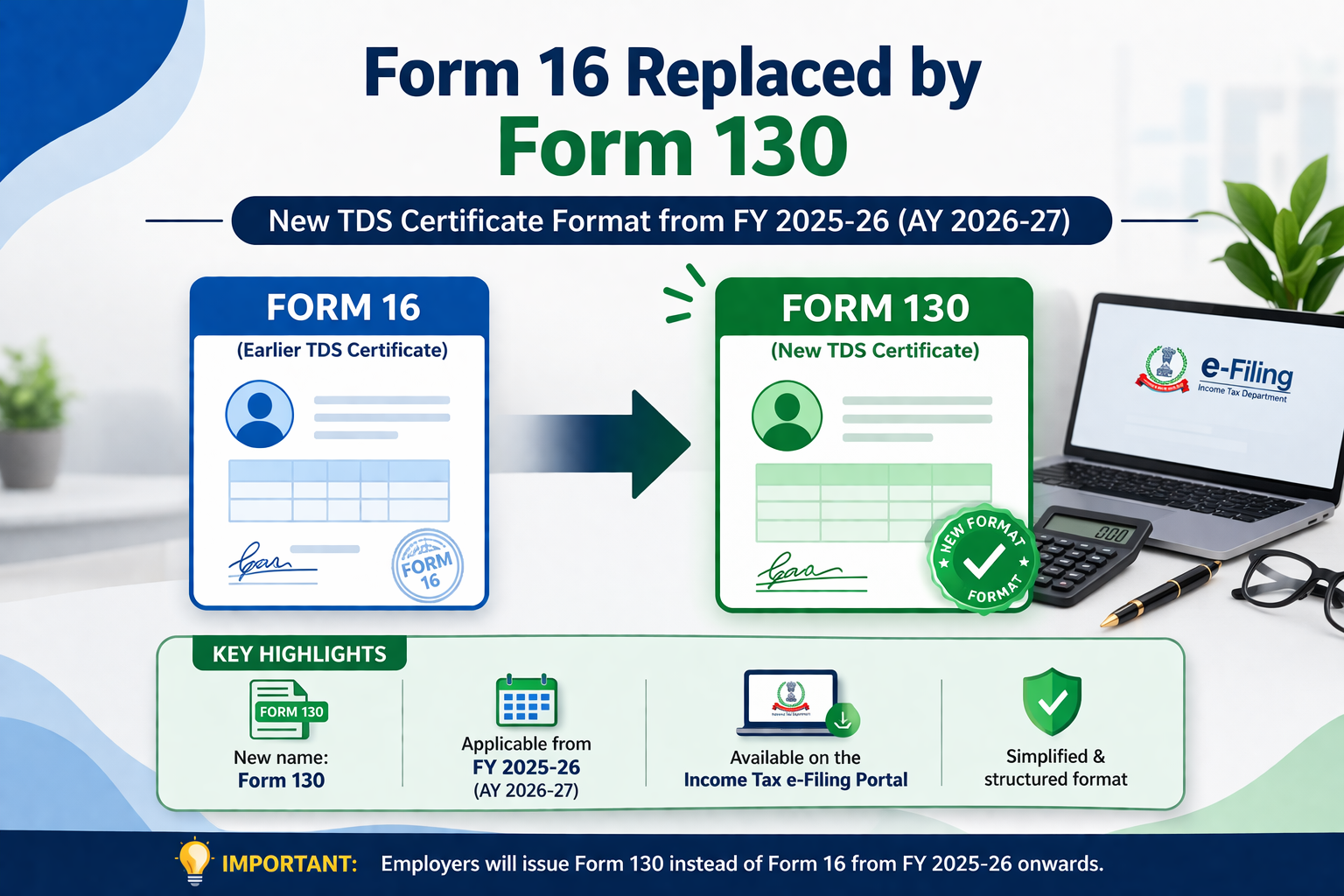
From April 1, 2026, Form 16 as you know it will no longer exist.
Under the new Income Tax Rules 2026, aligned with the Income Tax Act 2025, Form 16 is being replaced by a new document called Form 130. This is one of the most significant procedural changes for salaried taxpayers in recent years, and understanding it early will help you file your ITR for FY 2026-27 without confusion.
This article explains exactly what Form 130 is, how it is different from Form 16, what other forms are changing, and what you need to do differently.
Important clarification: The last Form 16 will be issued in June 2026 for FY 2025-26. The first Form 130 will be issued in June 2027 for FY 2026-27. So if you are filing your ITR for FY 2025-26 this year, you will still receive Form 16. Form 130 applies from FY 2026-27 onwards.
What Is Form 130?
Form 130 is the new TDS certificate that will replace Form 16 under the Income Tax Rules 2026. It serves the same fundamental purpose: it is proof that tax has been deducted from your salary and deposited with the government by your employer.
What changes is the structure, the level of detail, and how it is generated.
Form 130 has three parts:
| Part | What It Contains |
|---|---|
| Part A | Employer and employee details, PAN, TAN, and TDS information |
| Part B | Salary summary, exemptions claimed, deductions, and tax calculation |
| Part C | Detailed computation of total taxable income, tax payable, relief claimed, and TDS credit |
In comparison, the current Form 16 has only two parts: Part A (TDS details) and Part B (salary and deduction details). Form 130 adds a third part with a complete tax computation, giving a fuller picture of your entire tax position in one document.
Key Differences: Form 16 vs Form 130
| Feature | Form 16 (Current) | Form 130 (New) |
|---|---|---|
| Number of parts | 2 (Part A and Part B) | 3 (Part A, Part B, Part C) |
| Generation method | Employer can issue manually | Only through TRACES portal, no manual issuance |
| Data source | Employer fills in details | System-generated from TDS filings and AIS data |
| Tax computation | Basic summary | Full detailed computation in Part C |
| Coverage | Salaried employees | Salaried employees, pensioners, senior citizens with interest income |
| First issuance | Issued by June 15 annually | First Form 130 by June 15, 2027 (for FY 2026-27) |
| Scope for manual changes | Some scope | Significantly reduced |
Why Is Form 16 Replaced by Form 130?
The change is part of a broader overhaul under the Income Tax Act 2025, which replaces the Income Tax Act 1961. The government’s primary goal with Form 130 is to reduce mismatches between what employers report and what taxpayers declare in their ITR.
Currently, discrepancies between employer TDS data and taxpayer filings are one of the most common reasons for income tax notices. Form 130, being fully system-generated from verified TDS filings and AIS data, is designed to close this gap significantly.
The broader push is towards a data-driven, automated tax filing system where the ITR comes substantially pre-filled, manual data entry is minimal, and errors are detected automatically before processing.
As Tarun Garg, Director at Deloitte India, explained, the rationale is to remove duplication, simplify compliance, and align forms with the new Income Tax Act 2025 structure.
Other Forms That Are Being Renamed
Form 16 is not the only form being renamed. Several widely used income tax forms are being renumbered under the new rules. Here is a complete reference table:
| Current Form | New Form Number | Purpose |
|---|---|---|
| Form 16 | Form 130 | Salary TDS certificate (employer to employee) |
| Form 16A | Form 131 | TDS certificate for non-salary income (rent, interest, professional fees) |
| Form 26AS | Form 168 | Annual tax statement (all TDS credits on your PAN) |
| Form 24Q | Form 138 | Quarterly TDS statement filed by employers |
| Form 10F | Form 42 | Tax Residency Certificate application (for DTAA claims) |
| Section 80C | Section 123 | Tax deduction for investments (PPF, ELSS, etc.) |
The renumbering is purely administrative. The purpose and benefit of each form remains exactly the same. Only the reference numbers change.
For a complete understanding of deductions like Section 80C (now Section 123) and how they affect your ITR, read the dedicated guide.
What Happens to the ITR Forms?
Along with Form 130, the ITR forms themselves are being redesigned under the new Income Tax Rules 2026. The key changes in ITR forms include:
- Capital gains reporting: Short-term and long-term capital gains must be clearly separated, with specific reporting rules for each category. This affects anyone who has sold stocks, mutual funds, or property.
- More detailed deduction disclosures: Greater detail required when claiming deductions, including insurer name and policy number for health insurance claims under Section 80D.
- Asset disclosures: Additional disclosure requirements for taxpayers with complex investments, foreign assets, or overseas holdings.
- Holding period and valuation rules: Defined rules for how asset holding periods and valuations should be calculated and reported.
For most salaried professionals with straightforward income, the new ITR forms may actually be easier to fill because more data will be pre-filled from Form 130, AIS, and TDS records.
How This Affects You: Category-wise Breakdown
Salaried Professionals
The biggest change is receiving Form 130 instead of Form 16 from your employer in June 2027. The document will look different and have more detail, but it serves the same purpose. Pre-filled ITR data is expected to be more accurate, making filing faster and easier.
The key risk: if your employer delays or makes errors in their quarterly TDS filings, your Form 130 will reflect those errors. You will need to follow up with your HR or payroll team to get corrections done before the ITR filing season.
Pensioners and Senior Citizens
Form 130 explicitly covers pensioners and senior citizens earning interest income under Section 402(39) of the Income Tax Act 2025. This makes the reporting of pension and interest income more streamlined. Senior citizens who were previously managing multiple documents may find the consolidated Form 130 easier to work with.
Investors with Capital Gains
The redesigned ITR forms require more precise capital gains reporting. If you have sold stocks, mutual funds, or real estate during FY 2026-27, be prepared for more detailed disclosure requirements. The classification of gains as short-term or long-term must be accurate.
High Income Taxpayers and NRIs
Stricter disclosure requirements on assets and overseas holdings. NRIs claiming DTAA benefits will notice the renaming of Form 10F to Form 42, though the process remains the same.
Freelancers and Professionals
Form 16A, which is the TDS certificate for non-salary income like professional fees, rent, and interest, is being renamed to Form 131. The certificate still needs to be collected from clients and banks who deduct TDS on payments to you. For more information on income tax for self-employed professionals, read the income tax guide for freelancers.
Will Refunds Be Faster Under the New System?
There is no official change to refund timelines. However, the new system could indirectly improve refund speed.
If your Form 130 data matches your ITR filing exactly, the system is expected to process returns faster with fewer manual checks. On the other hand, any discrepancy between employer data and what you file will be detected quickly and could delay your refund until resolved.
The bottom line: accurate filing becomes even more important under the new system. Less room for manual corrections means errors surface faster.
What You Should Do Now to Prepare
- File your FY 2025-26 ITR normally. You will still receive Form 16 in June 2026 for FY 2025-26. The new Form 130 applies from FY 2026-27 onwards. No action needed for this year’s filing.
- Ensure your employer has your correct PAN linked. Form 130 is system-generated from TDS data. If your PAN is incorrectly recorded with your employer, it will affect the form generation.
- Verify your TDS is being deposited correctly throughout the year. Check your Form 26AS (soon to be Form 168) quarterly to ensure TDS deducted from your salary is being deposited. Errors need to be caught and corrected during the year, not at filing time.
- Keep investment proofs organized. Form 130 will include deductions in Part C, but accuracy depends on what your employer has recorded. Keep your own copies of all investment proofs and verify they match what appears in your Form 130.
- If you have capital gains, start maintaining proper records now. The new ITR forms require detailed short-term and long-term capital gains reporting. Start tracking your stock and mutual fund transactions with dates and amounts.
Frequently Asked Questions on Form 130
When will I receive Form 130 for the first time?
The first Form 130 will be issued by June 15, 2027, for FY 2026-27 (Tax Year 2026-27). For your ITR filing in 2026 (for FY 2025-26), you will still receive the regular Form 16.
Can my employer issue Form 130 manually?
No. Form 130 can only be generated and downloaded from the TRACES portal. Employers cannot issue it manually. For employers, the complete TDS compliance process and certificate issuance guidelines are available on the official Income Tax Department portal. This is a significant change from Form 16, where manual issuance was possible in some cases.
Is Form 130 completely different from Form 16?
It serves the same purpose but is more detailed. Form 130 has three parts instead of two, includes a complete tax computation in Part C, and is fully system-generated. The core information, salary, TDS, deductions, remains the same but with greater structure and detail.
Will my tax liability change because of Form 130?
No. Form 130 is a reporting and documentation change, not a tax law change. Your tax liability, slab rates, and deduction limits remain exactly the same. Only the format of the TDS certificate changes.
What happens to Form 26AS?
Form 26AS is being renamed to Form 168. It will continue to serve the same purpose, showing all TDS credits on your PAN from all sources. The renaming is administrative only.
What happens to Form 16A for non-salary TDS?
Form 16A is being renamed to Form 131. If you receive TDS certificates from banks (for FD interest) or clients (for professional fees), those will now be called Form 131. The purpose and process remain the same.
Will ITR filing become easier or harder?
For salaried professionals with simple income, filing is expected to become easier due to better pre-filled data. For investors and those with complex income, the new forms require more detailed reporting, which may feel more demanding initially.
What if there is a delay in my employer’s TDS filing?
Since Form 130 is generated only after quarterly TDS statements are processed, any delay in your employer’s TDS filing will delay your Form 130. Follow up with your HR or finance team to ensure TDS is filed on time each quarter.
The Big Picture: India’s Tax System Is Going Digital
The shift from Form 16 to Form 130 is not just a renaming exercise. It is part of a systematic move towards a fully integrated, data-driven tax filing ecosystem in India.
The government has been building towards this for years: AIS introduced in 2021, pre-filled ITR forms, real-time TDS matching. Form 130 is the next logical step, removing the last significant manual touchpoint in the employer-to-taxpayer tax documentation chain.
For honest taxpayers who file accurately, this system should make life simpler over time. Faster refunds, fewer notices, and less manual work at filing time are the expected outcomes.
The adjustment period will require attention. Familiarize yourself with the new form names, ensure your employer is filing TDS correctly, and verify your tax documents carefully when they arrive.
For a complete guide to ITR filing including step-by-step instructions for FY 2025-26, read how to file ITR online. And for the full picture of income tax including slabs and deductions, the Complete Income Tax Guide India 2025-26 and 2026-27 covers everything in detail.
Questions about the Form 130 transition or how it affects your specific situation? Drop them in the comments below.
📚 Also Read: