Old vs New Tax Regime: Which One Should You Choose? (FY 2025-26 and 2026-27)
Why This Decision Matters More Than Most People Realise
Every year without fail, the most common question salaried professionals ask during tax season is: “Which tax regime should I choose?”
The confusion is completely understandable. Since Budget 2020 introduced the new tax regime, crores of salaried professionals have been stuck on this decision. The wrong choice costs real money, and most people make it without doing a single calculation.
This guide breaks down the comparison with actual salary numbers so you can make the right call for your specific situation.
Let me be very clear upfront: there is no single “better” regime for everyone. The right choice depends entirely on your income level, your investments, and your lifestyle. By the end of this article, you will know exactly which one works for you.
Quick Note: Budget 2026 confirmed no changes to income tax slabs for FY 2026-27. The new Income Tax Act, 2025 is now effective from 1 April 2026, but the slab structure remains the same as announced in Budget 2025.
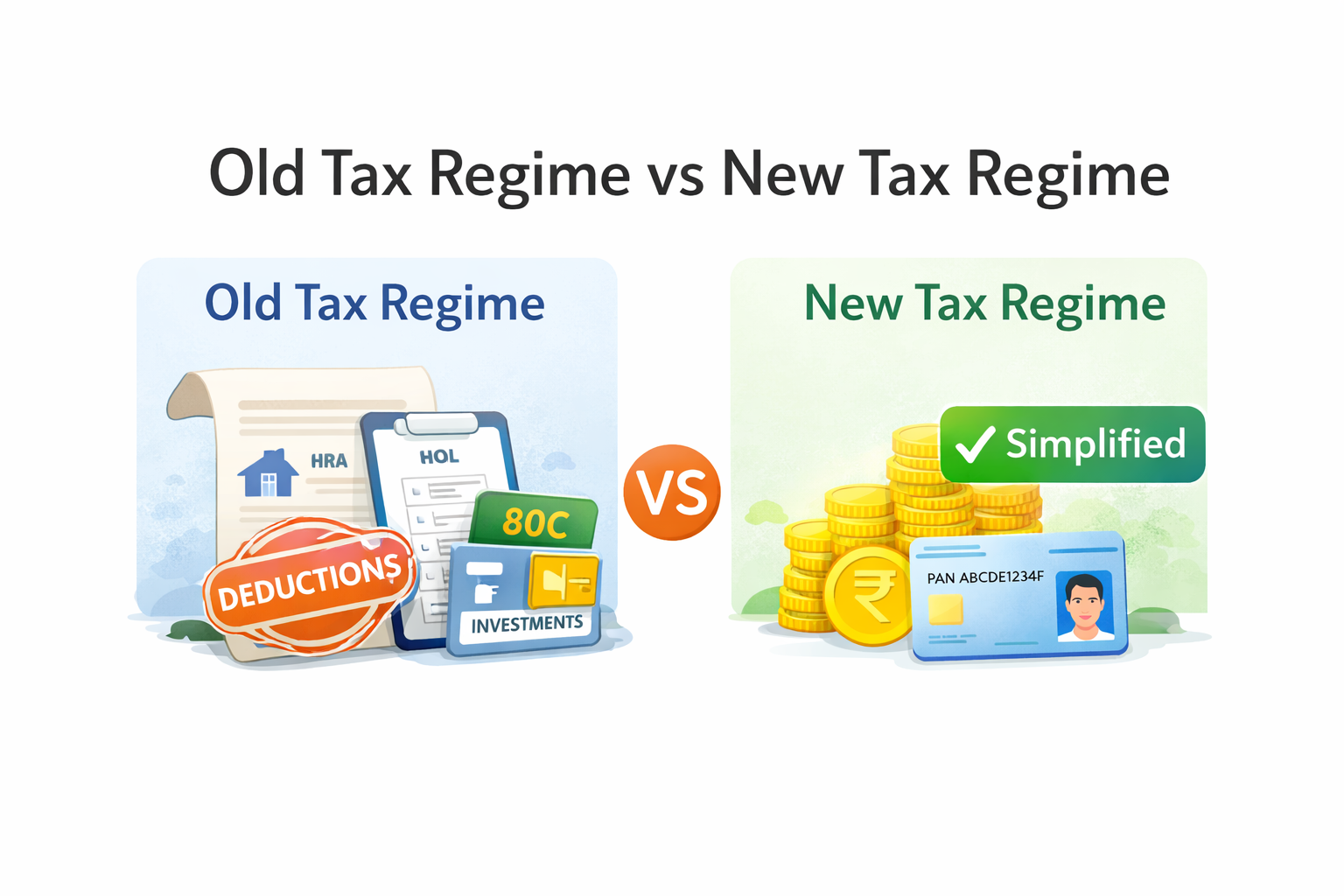
Old Tax Regime vs New Tax Regime: At a Glance
Before we go deep, here is a quick side-by-side overview to orient you:
| Feature | Old Tax Regime | New Tax Regime |
|---|---|---|
| Tax Slabs | Higher rates (5%, 20%, 30%) | Lower rates (5%, 10%, 15%, 20%, 25%, 30%) |
| Deductions Available | Yes (80C, 80D, HRA, etc.) | Very limited |
| Standard Deduction | Rs. 50,000 | Rs. 75,000 |
| Best For | High investments and deductions | Lower investments, simpler filing |
| Default Regime | No (opt-in required) | Yes (automatic from FY 2023-24) |
| Switching Allowed | Yes (salaried employees, every year) | Yes (salaried employees, every year) |
Income Tax Slabs: Old Regime vs New Regime (FY 2025-26 and FY 2026-27)
New Tax Regime Slabs (Default)
| Income Range | Tax Rate |
|---|---|
| Up to Rs. 4,00,000 | Nil |
| Rs. 4,00,001 to Rs. 8,00,000 | 5% |
| Rs. 8,00,001 to Rs. 12,00,000 | 10% |
| Rs. 12,00,001 to Rs. 16,00,000 | 15% |
| Rs. 16,00,001 to Rs. 20,00,000 | 20% |
| Rs. 20,00,001 to Rs. 24,00,000 | 25% |
| Above Rs. 24,00,000 | 30% |
Important: Under the new regime, taxpayers with income up to Rs. 12,00,000 pay zero tax after the rebate under Section 87A. For salaried individuals, this limit effectively becomes Rs. 12,75,000 (due to the Rs. 75,000 standard deduction).
Old Tax Regime Slabs
| Income Range | Tax Rate |
|---|---|
| Up to Rs. 2,50,000 | Nil |
| Rs. 2,50,001 to Rs. 5,00,000 | 5% |
| Rs. 5,00,001 to Rs. 10,00,000 | 20% |
| Above Rs. 10,00,000 | 30% |
Under the old regime, taxpayers with income up to Rs. 5,00,000 also pay zero tax due to Section 87A rebate.
What Deductions and Exemptions Are Available in Each Regime?
This is where the real difference lies. In my 6 years of teaching finance, I have found that most people do not realise just how many deductions the old regime offers, and how few the new regime allows.
Deductions Available in the Old Regime
- Section 80C: Up to Rs. 1,50,000 for investments in PPF, EPF, ELSS, LIC, NSC, home loan principal, etc.
- Section 80D: Health insurance premium for self and family
- HRA (House Rent Allowance): Exemption based on actual rent paid. Use our HRA Calculator to find your exact exemption amount.
- Standard Deduction: Rs. 50,000 for salaried employees. Read more about standard deduction for salaried individuals.
- Section 80E: Education loan interest deduction
- Section 80G: Donations to charitable organisations
- Section 24(b): Home loan interest up to Rs. 2,00,000
- LTA (Leave Travel Allowance): For travel within India
- Section 80TTA/80TTB: Savings account interest deduction
- Professional Tax: Deductible from salary income
- Section 10 exemptions: Children’s education allowance, hostel allowance, etc.
Deductions Available in the New Regime
The new regime is deliberately simple. You cannot claim most deductions. Here is what is still available:
- Standard Deduction: Rs. 75,000 for salaried employees (higher than old regime)
- Employer contribution to NPS: Under Section 80CCD(2), up to 14% of basic salary
- Agniveer Corpus Fund: Section 80CCH deduction
- Gratuity exemption
- Leave encashment on retirement
That is essentially it. No 80C, no 80D, no HRA exemption, no home loan interest deduction. To understand how these deductions affect your overall income tax calculation, read my complete guide.
Real Calculation: Who Saves More?
Let me show you actual numbers. This is what I do with my students in class, and I find it always makes things crystal clear.
Case 1: Salary of Rs. 8,00,000 per year (with investments)
Assumptions: PPF/ELSS investments of Rs. 1,50,000, Health insurance premium Rs. 25,000, HRA exemption Rs. 60,000
| Calculation Step | Old Regime | New Regime |
|---|---|---|
| Gross Salary | Rs. 8,00,000 | Rs. 8,00,000 |
| Standard Deduction | (-) Rs. 50,000 | (-) Rs. 75,000 |
| HRA Exemption | (-) Rs. 60,000 | Not available |
| Section 80C | (-) Rs. 1,50,000 | Not available |
| Section 80D | (-) Rs. 25,000 | Not available |
| Taxable Income | Rs. 5,15,000 | Rs. 7,25,000 |
| Tax Payable | Rs. 13,000 (approx.) | Rs. 16,250 (approx.) |
Winner for Rs. 8 lakh with investments: Old Regime saves more.
Case 2: Salary of Rs. 8,00,000 per year (without significant investments)
Assumptions: No 80C investment, No health insurance, Living in own house (no HRA)
| Calculation Step | Old Regime | New Regime |
|---|---|---|
| Gross Salary | Rs. 8,00,000 | Rs. 8,00,000 |
| Standard Deduction | (-) Rs. 50,000 | (-) Rs. 75,000 |
| Taxable Income | Rs. 7,50,000 | Rs. 7,25,000 |
| Tax Payable | Rs. 65,000 (approx.) | Rs. 16,250 (approx.) |
Winner for Rs. 8 lakh without investments: New Regime saves a lot more.
Case 3: Salary of Rs. 15,00,000 per year
Assumptions: 80C investments Rs. 1,50,000, Health insurance Rs. 25,000, HRA exemption Rs. 1,20,000, Home loan interest Rs. 2,00,000
| Calculation Step | Old Regime | New Regime |
|---|---|---|
| Gross Salary | Rs. 15,00,000 | Rs. 15,00,000 |
| Standard Deduction | (-) Rs. 50,000 | (-) Rs. 75,000 |
| HRA Exemption | (-) Rs. 1,20,000 | Not available |
| Section 80C | (-) Rs. 1,50,000 | Not available |
| Section 80D | (-) Rs. 25,000 | Not available |
| Home Loan Interest (Sec 24b) | (-) Rs. 2,00,000 | Not available |
| Taxable Income | Rs. 9,55,000 | Rs. 14,25,000 |
| Tax Payable | Rs. 1,12,500 (approx.) | Rs. 1,66,250 (approx.) |
Winner for Rs. 15 lakh with full deductions: Old Regime saves around Rs. 53,750 more.
The Break-Even Point: At What Deduction Amount Does Old Regime Win?
This rule of thumb works well as a quick guide before doing the full calculation:
- If your total deductions (80C + 80D + HRA + others) exceed approximately Rs. 3,75,000 at higher income levels, the old regime generally saves more.
- If your deductions are below Rs. 2,00,000, the new regime almost always wins.
- In the Rs. 2,00,000 to Rs. 3,75,000 range, you need to calculate both and compare.
The honest answer? Always calculate both. There is no shortcut. Even I run the numbers every year.
Which Regime Is Better for Salaried Employees?
Based on working with professionals across income brackets, here is the pattern that holds true most consistently:
Choose the Old Regime if you:
- Have home loan interest payments (Section 24b deduction of up to Rs. 2 lakh)
- Pay significant house rent and claim HRA exemption. Calculate your HRA benefit using our HRA Calculator.
- Invest Rs. 1,50,000 in 80C every year (PPF, ELSS, EPF, LIC, etc.)
- Have health insurance and claim 80D
- Have an education loan with interest payments
- Are in the Rs. 10 lakh to Rs. 20 lakh income bracket with large deductions
Choose the New Regime if you:
- Are a young earner with little to no investments yet
- Live in your own home and cannot claim HRA
- Have no significant Section 80C investments
- Prefer simpler ITR filing without tracking deductions
- Earn below Rs. 12,75,000 (effectively zero tax after rebate and standard deduction)
- Receive significant employer NPS contribution (80CCD2 is allowed in new regime)
Which Regime Is Better for Business Owners and Freelancers?
This is a slightly different situation. If you have business income (income from profession or business under any head other than salary), you can switch regimes only once in a lifetime. After that, if you opt back to the old regime, you cannot switch to new again.
Self-employed professionals and business owners need to be far more careful before making this call. Consulting a CA before switching is strongly recommended.
For freelancers and self-employed professionals, this restriction is critical to understand. I have covered income tax for freelancers in a separate detailed article.
Common Myths About the Two Regimes
Myth 1: “The new regime is always cheaper because rates are lower”
Not true. Lower slab rates do not automatically mean lower tax if you lose valuable deductions. As I showed in Case 3 above, a person with Rs. 15 lakh income can pay Rs. 53,000 more in the new regime.
Myth 2: “If I choose new regime, I cannot invest in PPF or ELSS”
Completely false. You can still invest in PPF, ELSS, NPS, or anything else under the new regime. You just will not get a tax deduction on those investments. The investment itself is not restricted.
Myth 3: “I am stuck with whichever regime I choose”
Not true for salaried employees. You can switch every single year when filing your ITR. Just declare your choice to your employer at the beginning of the financial year for TDS purposes, and you can revise it when you actually file.
Myth 4: “The new regime is always better for people below Rs. 7 lakh”
Mostly true, but not always. If you have HRA exemption, 80C investments, and 80D, even at Rs. 7 lakh the old regime might be competitive. Always calculate.
How to Decide: My Step-by-Step Framework
Follow this step-by-step process to find your answer with actual numbers:
- Calculate your gross salary for the year (or estimated salary if it is the beginning of the year).
- List all your deductions you can genuinely claim: 80C investments, health insurance premium, HRA amount, home loan interest, education loan interest, etc.
- Calculate taxable income under old regime: Gross salary minus standard deduction (Rs. 50,000) minus all deductions.
- Calculate tax under old regime using the old slab rates.
- Calculate taxable income under new regime: Gross salary minus standard deduction (Rs. 75,000) only.
- Calculate tax under new regime using the new slab rates.
- Compare both numbers. Whichever is lower, that is your regime.
Use our HRA Calculator to quickly find your HRA exemption amount before doing this comparison.
The 80CCD(2) Advantage in the New Regime
One thing most people miss: under the new regime, if your employer contributes to your NPS account, that contribution is deductible under Section 80CCD(2), even in the new regime.
From FY 2024-25 onwards, the limit has been increased to 14% of basic salary for private sector employees (up from 10%).
This is a significant benefit. If your employer offers NPS contribution, the new regime becomes even more attractive because you get this deduction on top of the Rs. 75,000 standard deduction.
This is one reason the government is pushing the new regime, and it is genuinely useful for people whose employers offer NPS contribution as part of the CTC.
What Happens If You Do Not Choose?
Since FY 2023-24, the new tax regime is the default. If you do not actively choose a regime when filing your ITR or informing your employer, you will automatically be placed in the new tax regime.
So if you want the old regime, you must actively opt for it. This is an important change that many of my students missed in the first year it was implemented.
Frequently Asked Questions
Can I switch between old and new tax regime every year?
Yes, if you are a salaried employee. You can choose a different regime each financial year when you file your income tax return. However, if you have business income, switching is restricted to once in a lifetime (back to old regime).
Is 80C deduction available in the new tax regime?
No. Section 80C deduction is not available under the new tax regime. You can still invest in PPF, ELSS, or NPS, but you will not get the tax deduction benefit on those investments.
Which regime is better for a salary of Rs. 10 lakh?
It depends on your deductions. If you have home loan interest, HRA, and full 80C investments, the old regime is likely better. If you have minimal deductions, the new regime at Rs. 10 lakh will result in lower tax. Always calculate both.
Is HRA exemption available in the new tax regime?
No. HRA exemption is not available under the new tax regime. Use our HRA Calculator to find how much HRA exemption you would lose before deciding which regime to choose.
Is standard deduction available in the new regime?
Yes. The standard deduction of Rs. 75,000 is available in the new tax regime for salaried employees. It is actually higher than the Rs. 50,000 standard deduction in the old regime. Read more about standard deduction for salaried individuals.
Is the new tax regime compulsory from FY 2026-27?
No, it is not compulsory. The new regime is the default, but you can still opt for the old regime by actively choosing it while filing your ITR. Budget 2026 made no changes to this structure.
Which regime is better for home loan borrowers?
Generally the old regime, because Section 24(b) allows deduction of home loan interest up to Rs. 2,00,000. This deduction is not available in the new regime. For someone with a home loan, this alone can be a decisive factor.
Can senior citizens choose between both regimes?
Yes, senior citizens can also choose between both regimes. However, senior citizens have a higher basic exemption limit under the old regime (Rs. 3,00,000 for those aged 60 to 79, and Rs. 5,00,000 for super seniors aged 80 and above), which may make the old regime more attractive for them.
Final Verdict: Old Regime vs New Regime
After 6 years of working through these calculations with salaried professionals across income levels, the honest conclusion is this:
Do not follow general advice. Do your own calculation.
The new regime is genuinely excellent for young earners, people without investments, and anyone earning below Rs. 12,75,000 who wants zero tax without any paperwork. The government has designed it to be simple and attractive for this segment.
The old regime rewards disciplined investors. If you have a home loan, pay rent, invest regularly in 80C instruments, and have health insurance, the old regime almost always gives you a lower tax bill.
The good news is that as a salaried employee, you can recalculate and switch every year. So even if you choose wrong this year, you can correct it next year.
In my experience, the people who benefit most from the old regime are those in the Rs. 10 lakh to Rs. 25 lakh income range who have home loans and are disciplined about tax-saving investments. For everyone else, the new regime is worth serious consideration.
For a complete understanding of how income tax works in India, read my Complete Income Tax Guide India 2025-26 and 2026-27. It covers everything from tax slabs to ITR filing in detail.
And if you want to understand your standard deduction or which ITR form to file, I have covered those topics in detail as well.
If you have questions about your specific situation, drop them in the comments below. I read every comment and try to respond to as many as I can. For women taxpayers specifically, read our guide on income tax for women FY 2026-27. The current tax structure was shaped by Union Budget 2025 — read it for context on how slabs were revised. Related reading: PPF interest rate and tax benefits, trading tax in India, share buyback tax rules 2026, sovereign gold bond tax rules, credit card high value transactions, and deferred tax liability.
📚 Also Read:
- Income Tax Slabs FY 2026-27: New vs Old Regime Rates
- Understanding 87A Rebate in New Tax Regime
- Standard Deduction FY 2026-27: Rs. 75,000 for New Regime
- Section 80C Deductions: Complete List for FY 2025-26
- Tax Saving Tips for Salaried Employees FY 2026-27
- Complete Income Tax Guide India 2025-26 & 2026-27